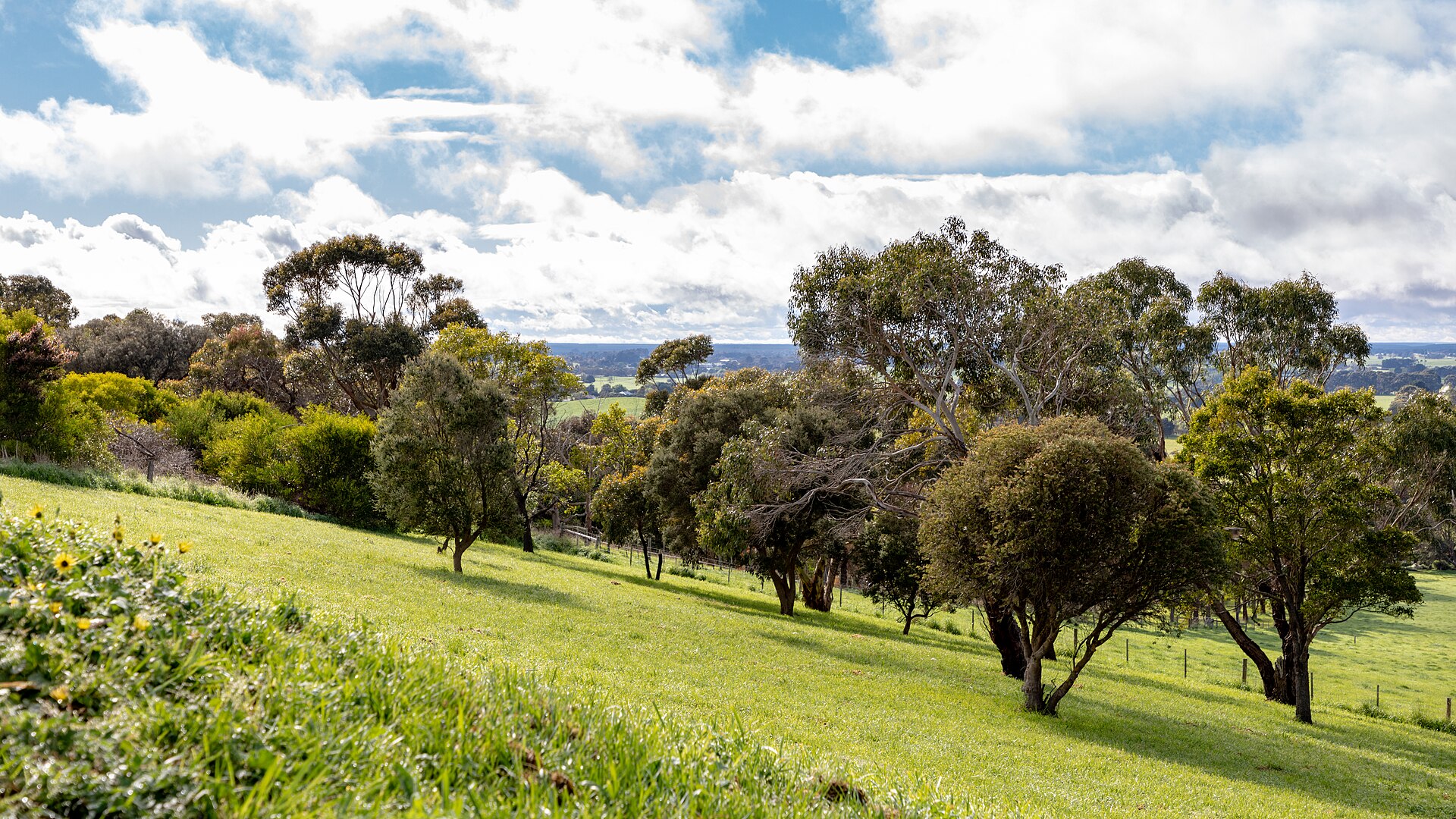
Before the drains, much of the Limestone Coast spent winter underwater. The scheme that dried it out reshaped the land - and made the surviving wetlands precious.
A land underwater
The first European settlers of the South East found a landscape that barely qualified as land for half the year. Rain falling on the flats between the old coastal dune ranges had nowhere to go: it pooled in vast seasonal swamps and lagoons, and travellers between stations could ride for days through shallow water. Good soil lay everywhere - under a metre of winter flood.
The great drains
From the 1860s onward, successive governments cut drains through the limestone ranges to let the water out to sea, a public-works campaign that continued for more than a century and remade the region into some of Australia's most productive grazing and cropping country. The scale of it is hard to grasp until you stand somewhere like the Woakwine Cutting near Beachport - a canyon through an entire range, dug between 1957 and 1960 largely by one determined farmer and a single offsider, to drain one swamp.
The drains gave the South East its farms, its towns and its roads. They also erased the overwhelming majority of its wetlands, and with them the great gatherings of waterbirds the first surveyors described.
What survived
That is what makes the remnants so valuable. Bool Lagoon, south of Naracoorte, survives as one of southern Australia's most important freshwater wetland systems, its seasonal waters still drawing brolgas, ibis and ducks in their thousands. On the coast near Kingston SE, Butcher Gap Conservation Park keeps a working sample of the old salt-lake and swamp country. Behind Beachport, Lake George spreads across the flats the drains once fed, and at Port MacDonnell volunteers have spent decades restoring the wetland of Germein Reserve.
Reading the landscape
Once you know the story, you see it everywhere: the dead-straight watercourses beside the highways, the bridges over channels that flow only in winter, the sudden green of a flat that was a lagoon within living memory. The South East is a made landscape - and its surviving wild corners, from sinkholes to lagoons, are catalogued in our guide to the natural wonders of the Limestone Coast.